
Cell-Avie is skincare that accepts life instead of fighting it: face creams, serums and hair serums whipped from grass-fed beef tallow — lipids the skin already speaks — finished with Matrixyl-class signal peptides and quiet botanicals. Moisture, softness, glow. That is the promise, and it is the whole promise.
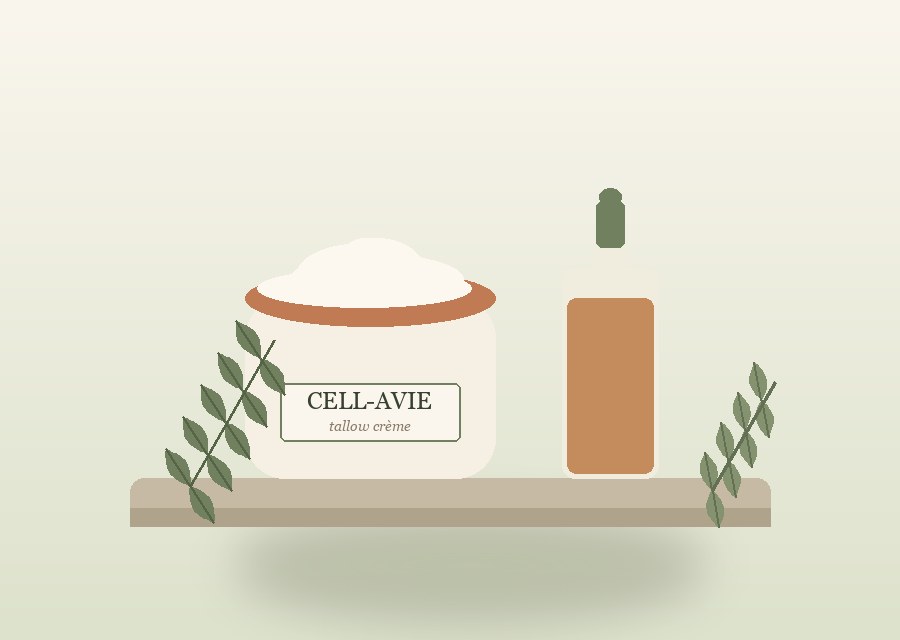
Four steps, no sermon. The full shelf lives on The Ritual.
The daily face cream: whipped grass-fed tallow with the house peptide complex. Melts on contact, stays as comfort.
The peptide serum: a light tallow-and-botanical base for damp skin, morning and evening, before the cream.
The everywhere balm — hands, elbows, winter cheeks. One warm layer of oleic-palmitic-stearic comfort.
The small pot for the small places: knuckles, lip contour, wherever weather arrives first.
Tallow-derived lipids lightened with botanical oils for lengths and ends — two drops, towel-dried hair.
Serum, cream, balm where needed, hair last. Sixty seconds, twice a day. C'est la vie — keep it easy.
Skin is wrapped in lipids; it makes sense to feed it lipids it recognizes. Grass-fed tallow's fatty-acid profile overlaps with the skin's own surface chemistry — and the house renders it gently enough that the cream smells of its botanicals, not its base.
Oleic acid (~36%), palmitic acid (~25%), stearic acid (~19%): tallow's three leading fatty acids belong to the same families found in human skin surface lipids. That overlap is why a good tallow cream spreads like it belongs.
Two cosmetic jobs, one lipid: tallow softens the surface and slows water loss through it. The result you can feel — supple, cushioned skin — is the result we claim. Nothing beyond it.
Animal fats are among the oldest cosmetic bases known. When a 2024 scoping review examined tallow's biocompatibility with skin, it found the composition suitable — and the formal research still thin. We say both, proudly.
Russell MF et al., Cureus (2024) — PubMed scoping review
The house starts with grass-fed suet, wet-renders at low temperature and filters to a pale, near-scentless lipid — a clean, quiet base for the botanicals and peptides that follow.
In 1993, researchers showed that a five-amino-acid fragment of type I procollagen — KTTKS — encourages fibroblasts to produce matrix components in culture. Attach a palmitic tail and you have palmitoyl pentapeptide, the Matrixyl-class signal peptide found in serious leave-on formulas worldwide. Cosmetic reviews place such peptides in the service of appearance: skin that looks firmer, smoother, better rested.
Peptide design happens to be the family trade: the Cell-Avie / Celluvière house comes from the Panacea family, whose Panacea Bio Chem laboratory works in amino-acid-chain design and formulation. The house's peptide direction is composed with that expertise — in strictly cosmetic measure, for strictly cosmetic ends.
Appearance claims only · cosmetics, not medicineCell-Avie and Celluvière are two presentations of one natural-cosmetics house, founded by the Panacea family. Cell-Avie is the warm one — sage and terracotta, an easy smile, a French saying for a name. The facts, the lipids and the peptides are shared; the voice is its own. The longer telling is on The House.
Like c'est la vie — such is life — and like cell à vie: a cell, for life. Skin care as daily acceptance, not a battle.
Its oleic, palmitic and stearic acids also occur in the skin's own surface lipids. In a formula it is emollient and occlusive: softening, moisture-holding, cushioning.
Signal peptides of the palmitoyl pentapeptide (Matrixyl) class, used for the appearance of firmness and smoothness. Cosmetic ingredients; cosmetic aims.
It is one face of the Cell-Avie / Celluvière house, founded by the Panacea family, with Panacea Bio Chem's peptide expertise behind the formulation direction. More on the Questions page.